
GKS guide
GKS-U vs GKS-G: Undergraduate or Graduate?
The Global Korea Scholarship runs two separate programs: one for undergraduate degrees and one for graduate degrees. Here is how they differ and which one you apply to.
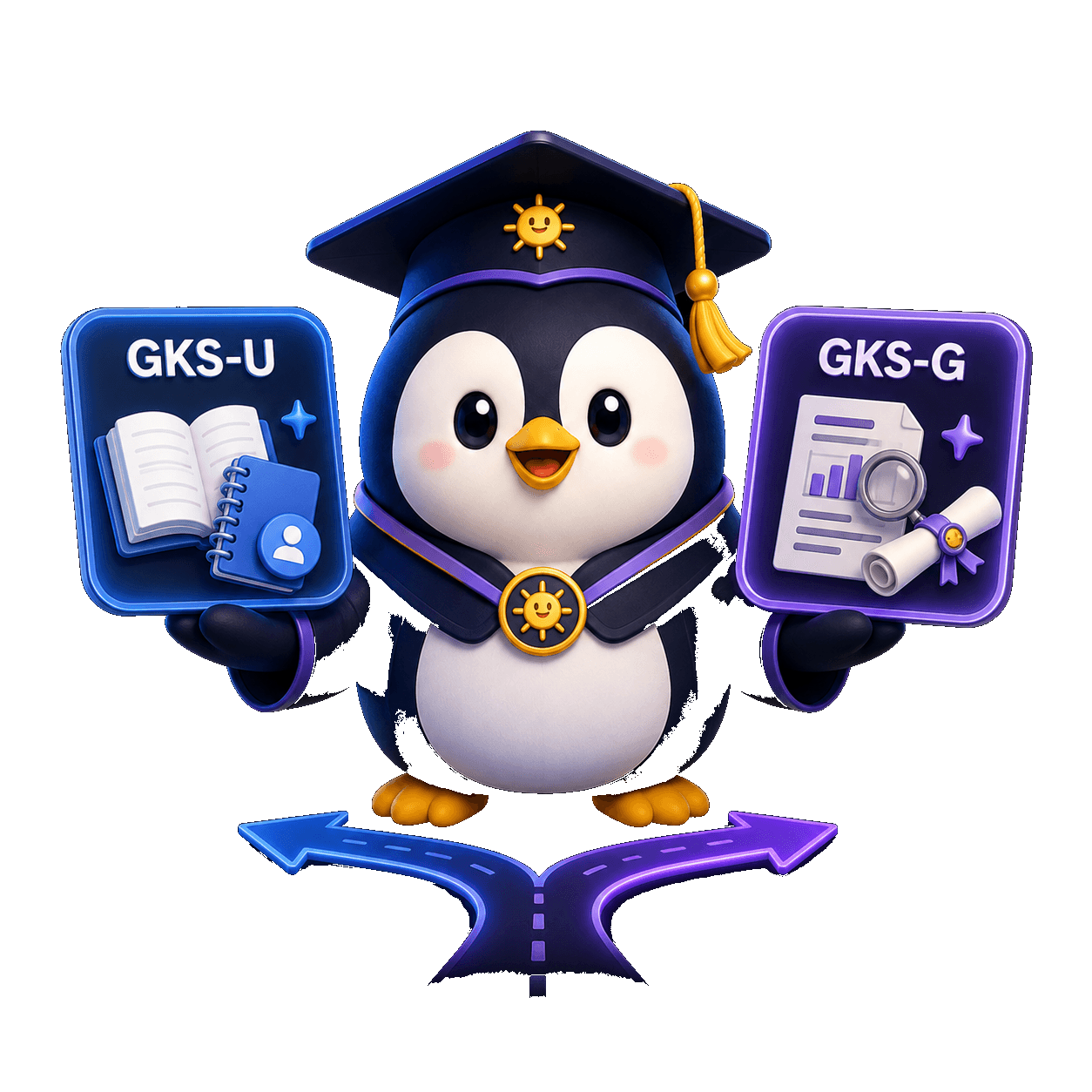
GKS-U · Undergraduate
- For
- High-school graduates (or expected) applying for an Associate or Bachelor's degree.
- Age limit
- Under 25 (born after 1 March 2002).
- Length
- Bachelor's: 1-year Korean course + 4–6 years. Associate: 1 year + 2–3 years.
- GPA baseline
- Top 20% of your class, or 80/100 (CGPA 2.64/4.0).
GKS-G · Graduate
- For
- Bachelor's holders applying for a Master's, and Master's holders applying for a Doctoral or Research program.
- Age limit
- Under 40, born after 1 September 1986 (under 45 for incumbent professors from ODA-recipient countries).
- Length
- Master's: 1 year + 2 years. Doctoral: 1 year + 3 years. Research: 6 months–1 year.
- GPA baseline
- Top 20% of your class, or 80/100 (CGPA 2.64/4.0).
Undergraduate or graduate — how to choose
The right program is set by the degree you already hold, not by preference. Finishing high school, or without a university degree yet? GKS-U is your route — it funds an associate or bachelor's degree and caps applicants at under 25. Already hold a bachelor's? Apply to GKS-G for a master's; a master's opens the doctoral and research tracks. GKS-G's age limit is far wider — under 40 — reflecting that graduate applicants are often already working.
What the two programs share matters as much as what divides them. Both fund a one-year Korean course before your degree (GKS-G's research, global network and English-taught tracks aside), both accept a TOPIK level or that funded year for the language requirement, and — the question most applicants ask — both screen grades against the identical baseline: the top 20% of your class, which you can line up with your own grading scale. Graduate study does not demand a higher GPA. Where they truly diverge is length: a GKS-U bachelor's runs four to six years; a GKS-G master's is two.
Compare GKS-U and GKS-G document requirements
What is the difference between GKS-U and GKS-G?
GKS-U is the undergraduate program, for high-school graduates pursuing an associate or bachelor's degree. GKS-G is the graduate program, for degree holders pursuing a master's, doctoral, or research program. They have different age limits, required prior degrees, and program lengths.
Which GKS program should I apply to?
Apply to GKS-U if you are finishing high school and want a bachelor's or associate degree in Korea. Apply to GKS-G if you already hold a bachelor's degree (for a master's) or a master's degree (for a doctoral or research program).
Can I apply to both GKS-U and GKS-G?
No. You apply to a single program through one track, and the guideline is blunt about filing both at once: the application is disregarded, and if it is found after selection the scholarship is cancelled. Failing the embassy track is different from hedging against it — an embassy-track applicant who is NOT selected in the first round may re-apply through the university track, but anyone who passed that round, backup candidates included, may not.
Do you need TOPIK for GKS? Which universities can you choose? Read the full GKS application guide Who cannot apply for GKS 2027 — the exclusion list See the GKS GPA conversion table
Source GKS-G — GKS Application Guidelines (NIIED / Study in Korea) · GKS-U — GKS Application Guidelines (NIIED / Study in Korea)Last verified Independent summary — GKS-U from the 2027 cycle, GKS-G from 2026; some details vary by track and can change. Always confirm against the published GKS Application Guidelines for your application year.